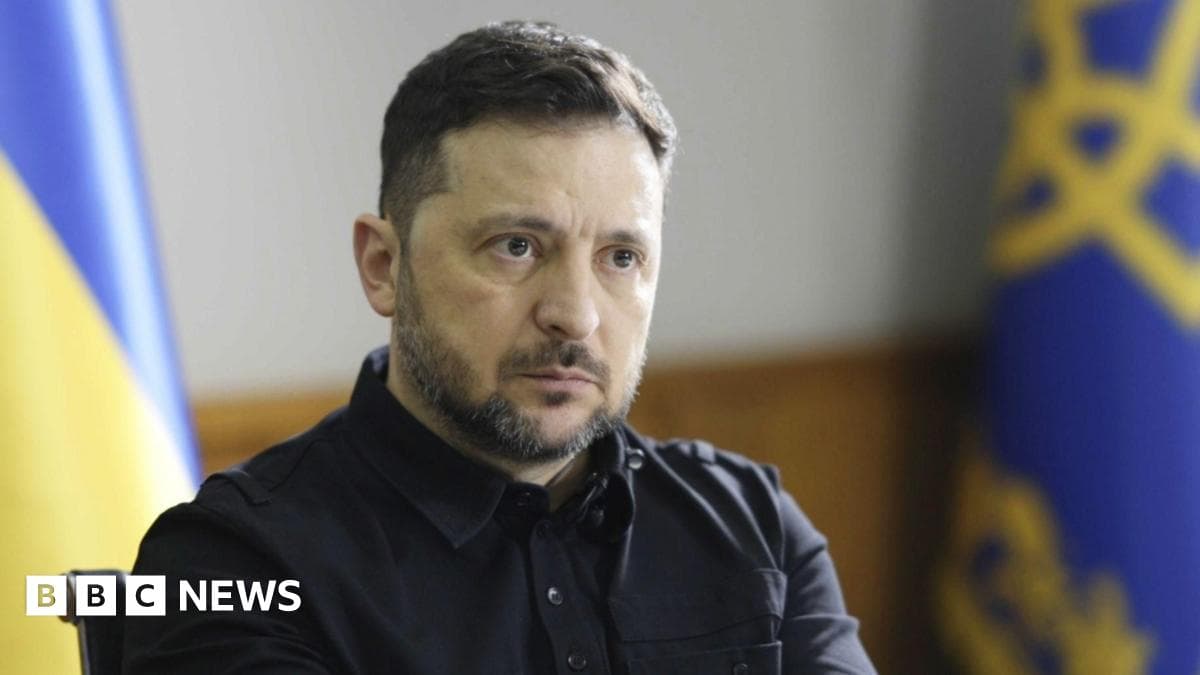
Ukrainian President Volodymyr Zelensky has issued a grave warning to the international community, declaring that Russian President Vladimir Putin has initiated "World War III" and must be decisively stopped to prevent catastrophic global escalation. The urgent pronouncement came during an exclusive interview with the BBC's Jeremy Bowen in Kyiv, just days before the four-year mark of Russia's full-scale invasion of Ukraine.
Speaking from the heavily fortified presidential compound in the Ukrainian capital, President Zelensky underscored the interconnectedness of global security, arguing that Russia's aggression extends far beyond Ukraine's borders. He emphasized that the ongoing conflict, which began with a full-scale invasion on February 24, 2022, represents a direct challenge to the international rules-based order, threatening stability across continents.
"This is not just a regional conflict; it is a global war that has already started," President Zelensky told the BBC. "Putin has crossed every red line imaginable, from nuclear threats to weaponizing food and energy. If we do not stop him now, decisively, the consequences will be felt by every nation, every family. This is World War Three, and we must recognize it as such."
The Ukrainian leader's remarks arrive at a critical juncture, with the conflict showing no signs of abatement and international efforts to broker a lasting peace largely stalled. His stark language reflects a growing frustration in Kyiv over what it perceives as insufficient global resolve to confront Russian aggression head-on, even as Ukraine continues to incur immense human and material losses.
A Stark Warning Amidst Escalation
President Zelensky's assertion of a burgeoning "World War III" is not merely rhetorical, according to officials in Kyiv. They point to Russia's sustained attacks on critical infrastructure, its increasingly aggressive posture towards NATO members through hybrid warfare tactics, and its deepening military alliances with states like Iran and North Korea as evidence of a broader, destabilizing agenda. The ongoing conflict has already triggered significant economic instability, fueled global inflation, and exacerbated humanitarian crises worldwide.
Dr. Oleksiy Danilov, Secretary of Ukraine's National Security and Defense Council, echoed the President's sentiments in a statement following the interview.
"President Zelensky's words are not hyperbole; they reflect the undeniable reality of an aggressor state challenging the very foundations of international order," Danilov stated. "The world cannot afford to be complacent. The cost of inaction will far outweigh the cost of uniting to stop this aggression now."
The interview, conducted in Kyiv, served as a poignant reminder of the enduring struggle four years after the full-scale invasion commenced. Despite the initial shock and widespread condemnation, the war has settled into a grinding conflict, prompting President Zelensky to continuously press allies for more robust and timely military assistance, including advanced weaponry and air defense systems.
Global Ramifications and the Call to Action
The imperative to "stop Putin" articulated by President Zelensky implies a multi-faceted approach, ranging from increased military aid and more stringent sanctions to bolstering collective defense alliances and fostering greater international unity. Ukraine has consistently called for the complete isolation of Russia on the world stage, arguing that anything less emboldens Moscow to continue its expansionist policies.
International relations experts note that while the term "World War III" is deeply alarming, Zelensky is effectively raising the stakes to compel a more decisive global response. "President Zelensky's use of 'World War III' is a strategic communication tool designed to jolt the international community out of any potential complacency," explained Dr. Eleanor Vance, a senior fellow at the Royal United Services Institute, in an interview.
"He is highlighting that the ripple effects of this war are not confined to Ukraine but have profound implications for global security, economic stability, and the future of democratic governance. It's a call to recognize the existential threat."
Western leaders have largely avoided using such definitive language regarding a "world war," instead emphasizing the need to support Ukraine's defense and hold Russia accountable for its actions. However, the sentiment of confronting Russian aggression remains a cornerstone of their policies. A spokesperson for the European Union's foreign policy chief, Josep Borrell, commented,
"We share President Zelensky's profound concerns regarding Russia's destabilizing actions. The international community remains united in its resolve to support Ukraine, uphold international law, and hold Russia accountable for its unprovoked aggression. The future of global security depends on our collective strength."
The Path Forward
As the four-year anniversary of the full-scale invasion approaches, the conflict continues to shape geopolitical dynamics, forcing nations to re-evaluate their defense strategies and international alliances. President Zelensky's impassioned plea to the BBC underscores the urgency he feels in securing comprehensive and sustained international support to counter Russia's persistent threats.
The coming months are expected to be critical, with both sides bracing for renewed offensives. For President Zelensky, the message is clear: the fight in Ukraine is a proxy for a larger global struggle against authoritarianism, and the international community's failure to recognize and act on this truth risks plunging the world into an even more dangerous and unpredictable era. His call to stop Putin is not just about Ukraine's survival, but about safeguarding global peace and stability against what he views as an unfolding worldwide conflict.