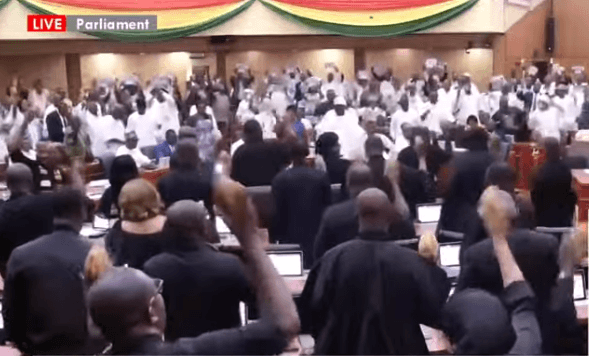
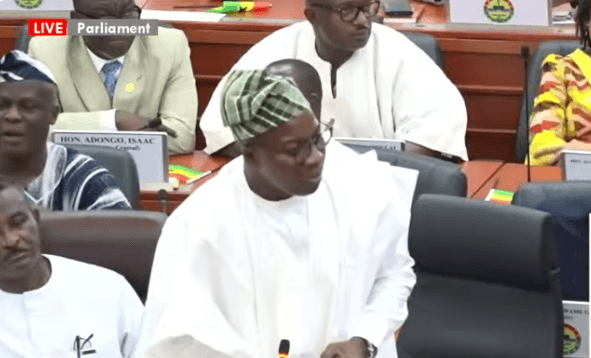
Accra, Ghana – Parliament erupted into a cacophony of chants and symbolic exchanges on Friday, February 27, as members of the Majority and Minority caucuses briefly clashed on the floor of the House immediately following President John Mahama’s State of the Nation Address (SONA). The spirited confrontation, which involved the waving of party paraphernalia and heated verbal exchanges, occurred moments after President Mahama concluded his address and began his departure, highlighting deep partisan divisions within the legislative body.
The incident unfolded with swift intensity. As President Mahama delivered his closing remarks, a palpable tension already hung in the air, punctuated by occasional murmurs and interjections from the opposition benches. However, the true eruption occurred once the President had finished speaking and commenced his exit. Members of the Majority side, buoyant from what they termed a successful and visionary address, began to chant "Mahama Ayekoo!" (Well done, Mahama!) and "Four More Years!" while holding aloft party scarves and miniature flags. This demonstration was met with an equally fervent response from the Minority, who countered with chants of "Yeresesamu!" (We are changing it!), "Lies!", and "Empty Promises!", brandishing placards that reportedly depicted images of economic hardship.
The exchange of symbols quickly escalated into a more direct, albeit brief, face-off. Some members from both sides reportedly moved towards the central aisle, engaging in animated gestures and pointed finger-wagging, though no physical altercation was reported. The Speaker of Parliament, observing the growing commotion, quickly called for order, and security personnel were seen positioning themselves to de-escalate the situation. Within minutes, the most intense aspects of the confrontation subsided, but the air remained thick with lingering animosity as the House prepared for its subsequent business.
Context of the State of the Nation Address
President Mahama’s State of the Nation Address is constitutionally mandated to inform Parliament and the nation about the country’s current condition, achievements, and future policy directions. On this occasion, the President focused heavily on economic growth indicators, infrastructure development projects, and social intervention programs, painting a picture of progress and resilience despite global economic headwinds. He specifically highlighted advancements in areas such as energy stability, road networks, and educational access.
However, the Minority caucus had consistently expressed skepticism regarding the government's narrative, frequently accusing the administration of mismanaging the economy and failing to alleviate the burdens on ordinary Ghanaians. Their immediate post-SONA reaction was therefore seen by many as a predetermined protest against what they perceived as a disconnect between the President’s address and the realities faced by citizens.
Reactions from Political Factions
Following the incident, spokespersons from both the Majority and Minority caucuses offered sharply contrasting interpretations of the events.
Hon. Kwesi Mensah, the Majority Chief Whip, defended his members' actions as a legitimate expression of support for the President’s vision. "Our members were simply expressing their profound appreciation for a visionary address that accurately reflected the progress Ghana is making," Hon. Mensah stated in a press briefing shortly after the session.
"It was the Minority who sought to disrupt the solemnity with their unwarranted heckling throughout the address and their provocative display of dissent afterward. We believe in constructive engagement, but we will not be silenced when celebrating the achievements of our President."
Conversely,
Hon. Nana Ama Opoku, the Minority Leader, vehemently condemned the President’s address, asserting that her caucus’s reaction was a necessary and authentic representation of public sentiment.
"The President presented a fantasy, detached from the suffering of ordinary Ghanaians. Our reaction was a reflection of the frustration of millions who feel ignored and misled," Hon. Opoku declared. "We cannot sit idly by while untruths are peddled as facts in the highest chamber of our land. The Majority’s attempt to stifle legitimate protest only exposes their disregard for democratic principles."
Implications for Parliamentary Decorum
Political analysts have weighed in on the implications of such parliamentary theatrics for the nation's democratic institutions. While acknowledging the passion inherent in partisan politics, many expressed concern over the erosion of decorum.
Dr. Ekow Botwe, a Political Scientist at the University of Ghana, emphasized the need for a balance between robust debate and respectful conduct.
"Such scenes, while brief, erode public confidence in our democratic institutions. Parliament should be a chamber of debate and deliberation, not a battleground for partisan theatrics," Dr. Botwe observed. "While dissent is vital in a democracy, the manner in which it is expressed must uphold the dignity of the House. Constant clashes risk alienating the very public Parliament is meant to serve."
The incident comes at a time of heightened political tension, with an upcoming general election looming on the horizon. Observers suggest that the fiery exchanges on the floor of Parliament are indicative of the intense political climate and the deep ideological fault lines that characterize contemporary Ghanaian politics.
The brief but intense clash underscores the increasing polarization within Ghana’s political landscape. While the House quickly regained its composure, the episode serves as a stark reminder of the challenges in fostering constructive dialogue amidst fervent partisan loyalties. As Parliament proceeds with its legislative agenda, the call for greater decorum and a renewed commitment to respectful debate remains a crucial aspiration for the health of Ghana’s democracy.