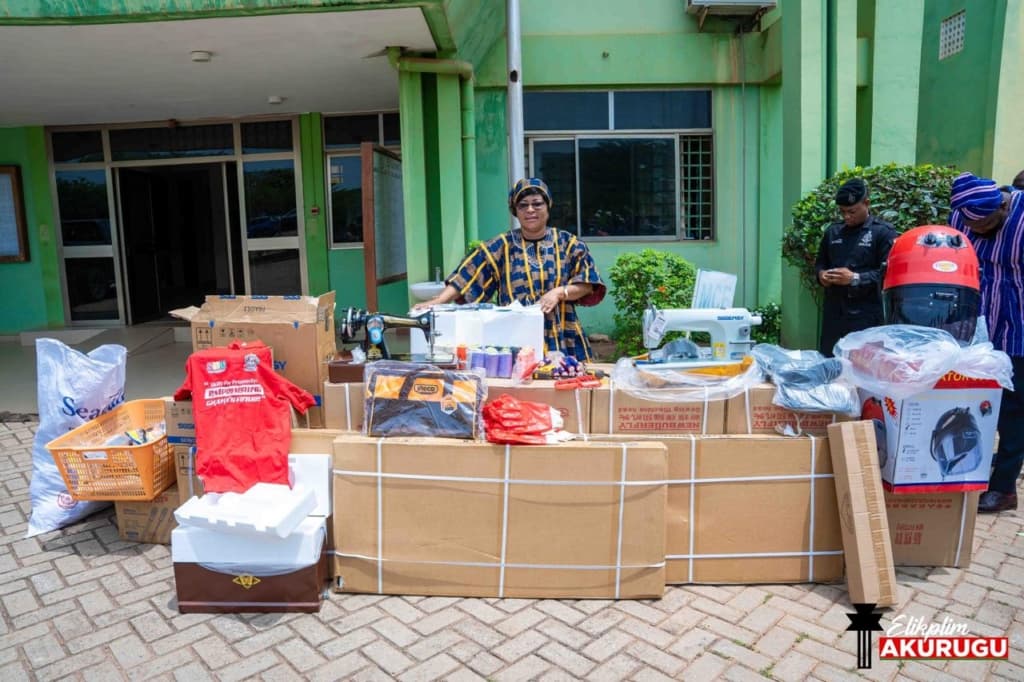
Dome-Kwabenya, Greater Accra – The Member of Parliament for Dome-Kwabenya, Faustina Elikplim Akurugu, has presented a significant assortment of tools and working equipment to master craftsmen and women in her constituency. The initiative, part of a concerted effort to bolster skills training under the government's National Apprenticeship Programme (NAP), aims to empower local artisans, enhance vocational education, and foster sustainable economic growth within the community.
The presentation, held at a vibrant ceremony attended by local leaders, beneficiaries, and community members, saw the distribution of essential equipment across various trades, including tailoring, carpentry, hairdressing, welding, and auto mechanics. This strategic intervention is designed to equip master artisans with modern resources, enabling them to provide superior training to their apprentices and improve the quality of goods and services produced locally.
Empowering the Backbone of Local Economies
Speaking at the event, MP Akurugu emphasized the critical role master artisans play in national development and youth empowerment. She highlighted that investing in their capacity directly translates into a more skilled workforce, reduced youth unemployment, and a robust local economy.
“This intervention is more than just a donation; it's a profound investment in the future of our youth and the economic resilience of Dome-Kwabenya,” MP Akurugu stated passionately. “By equipping our master artisans with the right tools, we are strengthening the backbone of our local economy and ensuring that the next generation receives high-quality, relevant skills training that meets contemporary industry standards. Our goal is to create a self-sufficient community where our youth can thrive and contribute meaningfully.”
The tools distributed ranged from industrial sewing machines and comprehensive carpentry sets to modern salon equipment, advanced welding gear, and specialized auto repair instruments. These resources are expected to bridge the gap between traditional apprenticeship methods and the demands of a rapidly evolving job market, allowing apprentices to gain hands-on experience with up-to-date technology.
The National Apprenticeship Programme: A Catalyst for Change
The National Apprenticeship Programme, under which this initiative falls, is a flagship government policy designed to formalize and upgrade Ghana's traditional apprenticeship system. It aims to provide structured, practical training pathways for young people, linking them directly with master artisans and businesses to acquire demand-driven skills. The programme seeks to address the critical issue of youth unemployment and foster a skilled workforce capable of driving national industrialization and economic diversification.
Dr. Kwame Mensah, Director of TVET Promotion at the Ministry of Education, who was present as a special guest, lauded MP Akurugu's proactive approach. He underscored the importance of local-level support for national policies.
“The National Apprenticeship Programme is a critical component of our national development strategy, aimed at creating a skilled workforce ready for the demands of the 21st-century economy,” Dr. Mensah explained. “Initiatives like the one by MP Akurugu perfectly complement national efforts, demonstrating a grassroots commitment to technical and vocational education and training (TVET). Such local interventions are vital for ensuring that the programme’s benefits reach every corner of the country and truly transform lives.”
He further reiterated the government's commitment to strengthening TVET institutions and promoting skills development as a viable and respected career path for Ghanaian youth.
Voices of Gratitude and Hope
The beneficiaries expressed overwhelming gratitude for the timely support, highlighting the immediate impact the new equipment would have on their operations and training capabilities. Madam Abena Owusu, a master seamstress who received a new industrial sewing machine, shared her excitement.
“For years, many of us have struggled to acquire modern equipment needed to train our apprentices effectively,” Madam Owusu said, tears welling in her eyes. “These new machines and tools will not only improve the quality of our work and productivity but also allow us to take on more apprentices and provide them with up-to-date skills that are relevant in today’s fashion industry. We are truly grateful to our MP for listening to our needs and delivering on her promise.”
Similarly, Mr. Kofi Mensah, a master carpenter, noted that the advanced carpentry sets would enable him to teach his apprentices more intricate designs and efficient construction techniques, ultimately leading to higher quality craftsmanship and better market opportunities for his trainees.
A Vision for Sustainable Development
The initiative is expected to have a far-reaching impact beyond the immediate beneficiaries. By strengthening the capacity of master artisans, the programme will lead to an increase in the number of well-trained apprentices entering the workforce, thereby reducing skill shortages and fostering entrepreneurship. It is also anticipated to boost local economic activity as improved quality and efficiency in production attract more customers and create a more competitive market.
MP Akurugu concluded the ceremony by urging the beneficiaries to make judicious use of the equipment and to continue their invaluable work of imparting skills to the next generation. She pledged her continued support for initiatives that promote education, skills development, and economic empowerment within the Dome-Kwabenya constituency.
This strategic injection of resources into the artisanal sector under the National Apprenticeship Programme serves as a testament to the power of targeted interventions and collaborative efforts between local leadership and national development goals. It lays a stronger foundation for a skilled, self-reliant, and prosperous Dome-Kwabenya, contributing significantly to Ghana’s broader development agenda.