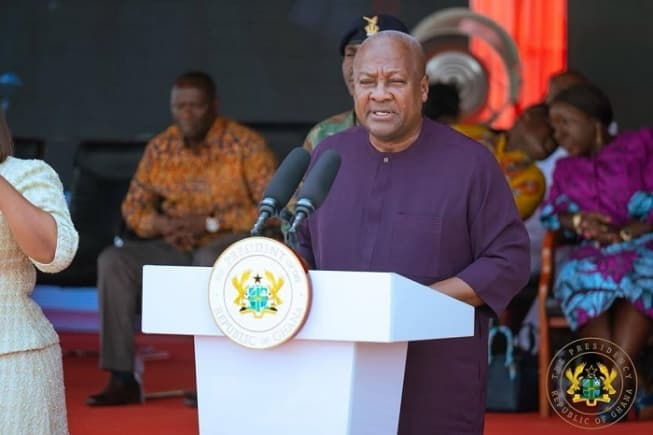
John Dramani Mahama has projected a 20 to 30 per cent reduction in Ghana’s steel imports as the government steps up efforts to expand domestic production.
He linked the strategy to new restrictions on non-ferrous scrap exports, a policy shift expected to generate up to $300 million annually from processed metal exports. According to the President, the measures form part of a broader industrial transformation agenda aimed at easing pressure on foreign exchange reserves, strengthening local supply chains and positioning Ghana as a competitive steel producer within West Africa.
Speaking at the commissioning of the second-phase expansion of B5 Plus Limited’s SBMS plant, President Mahama highlighted that Ghana’s annual steel demand exceeds 1.2 million metric tonnes. The demand, he said, is driven by sustained activity in construction, energy, mining and manufacturing.
He noted that a significant share of this demand has traditionally been met through imports, placing persistent strain on the country’s foreign exchange reserves. Expanding domestic steel production, he indicated, is intended not only to substitute imports but also to create value-added export opportunities and strengthen Ghana’s industrial base.
John Dramani Mahama said the second-phase expansion of B5 Plus Limited’s SBMS plant would significantly strengthen Ghana’s capacity to substitute steel imports and conserve foreign exchange.
“The expansion of this facility strengthens domestic capacity to substitute those imports, to save us foreign exchange, to improve our trade balance and to reduce exposure to global price volatility,” he stated.
According to the President, reducing steel imports by up to 30 per cent could save the country hundreds of millions of dollars annually in foreign exchange.
Scrap export restrictions and value addition
President Mahama announced plans to restrict the export of non-ferrous scrap to ensure local processors have improved access to critical raw materials. He noted that although Ghana generates substantial volumes of scrap metal from construction, demolition, vehicle imports and industrial activity, much of it is exported in raw form with minimal value addition.
Retaining scrap for domestic processing, he said, could increase processed metal exports by between $250 million and $300 million each year. The policy is also projected to create between 5,000 and 10,000 jobs across the metal value chain, while boosting government revenue through VAT, corporate income tax and PAYE contributions.
24-Hour Economy policy
The President disclosed that he had assented to the 24-Hour Economy Authority Bill a day earlier, formally granting legal backing to the flagship industrial policy. He indicated that B5 Plus would be among the first companies to register under the initiative.
An allocation of GH¢110 million has been made in the 2026 budget to operationalise the programme. The policy is expected to support energy-intensive industries such as steel manufacturing by enabling round-the-clock production, improving furnace efficiency and lowering unit costs.
“With industrial tariff reforms, improved grid stability and expanding domestic gas supply, manufacturing can operate competitively beyond the traditional hours,” he said.
Infrastructure and regional trade outlook
Commending B5 Plus for its tax compliance, President Mahama noted that the company has paid more than GH¢300 million in taxes and is on course to exceed GH¢500 million.
He linked the plant’s expansion to the government’s broader infrastructure drive including roads, railways, bridges, energy transmission lines, housing and industrial parks all of which rely heavily on iron and steel.
The President also urged a swift resolution of land litigation affecting the company’s expansion site to facilitate continued growth.
Finally, he highlighted Ghana’s role as host of the Secretariat of the African Continental Free Trade Area, describing it as a strategic opportunity for locally manufactured steel to access wider markets across West Africa and the continent.