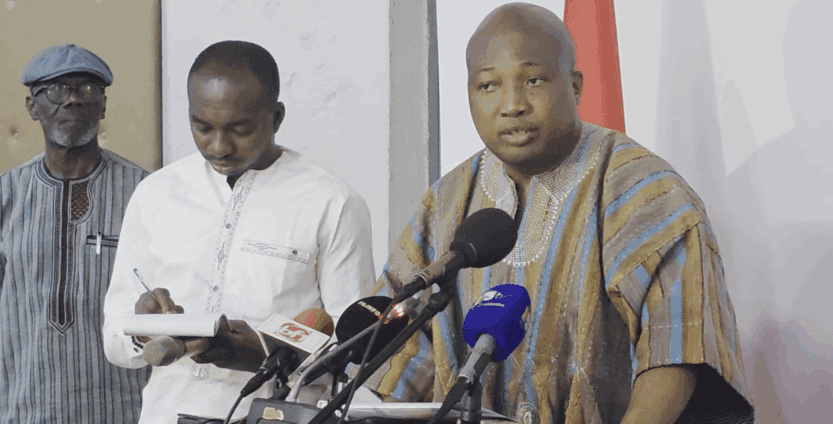
Samuel Okudzeto Ablakwa, Ghana’s Minister for Foreign Affairs, has announced the signing of a suite of bilateral agreements between Ghana and Burkina Faso aimed at deepening economic integration, strengthening border management, and enhancing security cooperation.
The development follows the recent extremist attack in Titao, which claimed the lives of eight Ghanaian nationals.
Speaking at a press conference in Burkina Faso on Friday, February 20, Mr. Ablakwa said the agreements fulfil directives issued by John Dramani Mahama and Burkina Faso’s leader, Ibrahim Traoré, who had tasked their foreign ministers to reactivate bilateral cooperation.
“I am delighted to report today that we have not only complied with the directives from our two presidents, but we have made a lot of progress,” he said.
Joint Resolve Against Extremism
Mr. Ablakwa stated that both governments strongly condemned the violent extremist assault in Titao, which killed several civilians, including Ghanaian tomato traders.
“We have decided to deepen our security cooperation. We are currently negotiating a security framework which will help us to work together and collectively to neutralise these violent extremists,” he noted.
He stressed that neither country wants the sub-region to become a haven for terrorist groups.
Driver’s Licence Pact to Ease Trade Corridor
Among the key agreements is the mutual recognition of national driver’s licences, a measure expected to remove long-standing bottlenecks along the Tema–Ouagadougou trade corridor.
Mr. Ablakwa explained that transport operators have long complained about regulatory inconsistencies between the two countries.
“Our drivers have been complaining for years about the lack of harmonisation. This agreement is going to resolve that, and it will boost intra-African trade,” he said.
READ ALSO: Ghana, Burkina Faso deepen security ties after terrorists kill 8 Ghanaians in Titao
He cited data from the United Nations Conference on Trade and Development showing that intra-African trade remains below 20 per cent. Ghana, which hosts the secretariat of the African Continental Free Trade Area Secretariat, is determined to lead efforts to remove barriers to free movement and commerce.
Transport, Border and Transit Cooperation
The two countries also signed:
An agreement on transport and road transit
A framework agreement on cross-border cooperation
A memorandum establishing periodic consultations between border administrative authorities
A memorandum creating a joint commission to reaffirm the Ghana–Burkina Faso border
A security cooperation agreement to tackle violent extremism
According to Mr. Ablakwa, these measures will strengthen security coordination while facilitating the movement of people and goods.
“We want to enhance our border collaboration so that we can enhance security and also facilitate the movement of our people,” he said.
Disaster Management Collaboration
Another major agreement focuses on joint prevention and management of disasters and humanitarian crises. This is partly in response to recurring flooding linked to the opening of the Bagre Dam in Burkina Faso, which has historically caused downstream flooding in northern Ghana.
“When we are not coordinating properly… it leads to the destruction of farms, of properties. Sometimes lives are lost,” he noted, stressing the importance of harmonised emergency preparedness protocols.
Joint Fight Against Illicit Drugs
Ghana and Burkina Faso also signed a cooperation agreement to combat the illicit cultivation, production, manufacturing, and trafficking of narcotic and psychotropic substances.
Mr. Ablakwa warned that drug abuse poses a growing threat to young people in both countries.
“It’s destroying the youth, destroying them of their future, their potential. Ghana and Burkina Faso will not be a dumping ground… we are going to enhance our cooperation to declare our countries a no-drug zone,” he stated.
Implementation Promised
Describing the discussions as “very substantive, meaningful, and impactful,” the minister assured that the agreements would be swiftly operationalised.
“These agreements are not going to be decorative pieces. We have discussed strategies for immediate implementation… and we are going to make sure that they are implemented very, very successfully,” he emphasised.
Officials say the strengthened bilateral framework is expected to significantly improve trade efficiency, border security, disaster preparedness, and youth protection along the Ghana–Burkina Faso corridor.