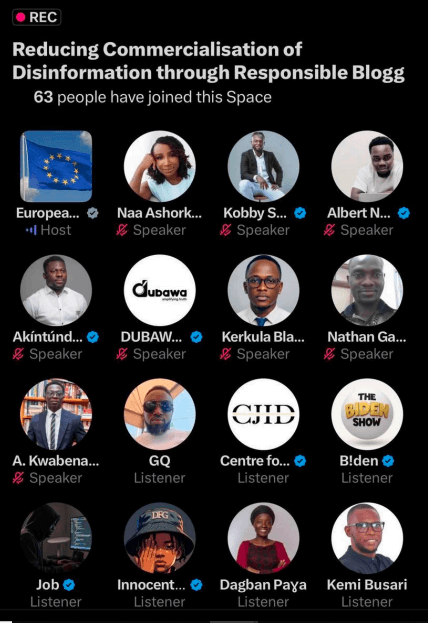
The webinar, organised by the Centre for Journalism Innovation and Development (CJID), DUBAWA, and the EU, provided a platform for stakeholders to engage in a tense but necessary conversation about truth, profit, and responsibility in the digital age. The forum's timing is particularly significant, given the increasing concern about the impact of digital falsehoods on the social fabric of West African countries.
"We can no longer afford to treat disinformation as a mere online nuisance; it has become a serious threat to our democratic institutions, public health, and national security,"said Mrs. Ngozi Ibe, a representative of the EU delegation to West Africa. The webinar's focus on responsible blogging and content creation reflects a growing recognition that the spread of disinformation is often driven by financial motives, with some bloggers and online publishers prioritising profits over fact-based reporting.
Confronting the Challenges of Monetised Disinformation
The webinar's discussions centered on the complex issues surrounding monetised disinformation, including the role of social media platforms, online advertising, and the need for greater transparency and accountability in the digital ecosystem. Mr. Desmond Orji, a fact-checking expert with DUBAWA, noted that "the lack of effective regulation and oversight in the digital space has created an environment in which disinformation can thrive, often with devastating consequences." The webinar participants emphasised the importance of collaborative efforts to develop and implement effective strategies for reducing the commercialisation of disinformation, including the promotion of fact-based reporting, media literacy, and critical thinking.
One of the key takeaways from the webinar was the need for bloggers and online content creators to prioritise ethical considerations in their work, recognising that the pursuit of profit should not come at the expense of truth and accuracy.
"As bloggers and content creators, we have a responsibility to our audiences to provide them with accurate and reliable information; we must not compromise our integrity for financial gain,"said Ms. Fatima Mohammed, a prominent blogger from Nigeria. The webinar also highlighted the importance of supporting independent fact-checking initiatives and promoting media literacy programs to help citizens critically evaluate online information and make informed decisions.
Looking Ahead: A Collective Response to Disinformation
The EU-DUBAWA webinar marks an important step in the regional effort to confront the challenges posed by monetised disinformation. As the digital landscape continues to evolve, it is clear that a collective response is necessary to mitigate the threats posed by commercialised falsehoods. Dr. Akanni noted that "the fight against disinformation requires a sustained and collaborative effort from all stakeholders, including governments, civil society, media organisations, and the private sector." The webinar's outcome is expected to inform the development of a regional strategy for reducing the commercialisation of disinformation, with a focus on promoting responsible blogging and content creation, supporting fact-checking initiatives, and enhancing media literacy.
In conclusion, the EU-DUBAWA webinar has initiated a critical conversation about the need for collective action to address the growing threat of monetised disinformation in West Africa. As the region continues to navigate the complexities of the digital age, it is essential that stakeholders work together to promote a culture of truth, accountability, and responsibility in the online space. By supporting independent fact-checking initiatives, promoting media literacy, and encouraging responsible blogging and content creation, we can mitigate the dangers posed by disinformation and foster a more informed, engaged, and resilient citizenry. The success of this effort will depend on the ability of stakeholders to work collaboratively, prioritising the common good over individual interests and recognising that the fight against disinformation is a shared responsibility that requires a sustained and collective response.