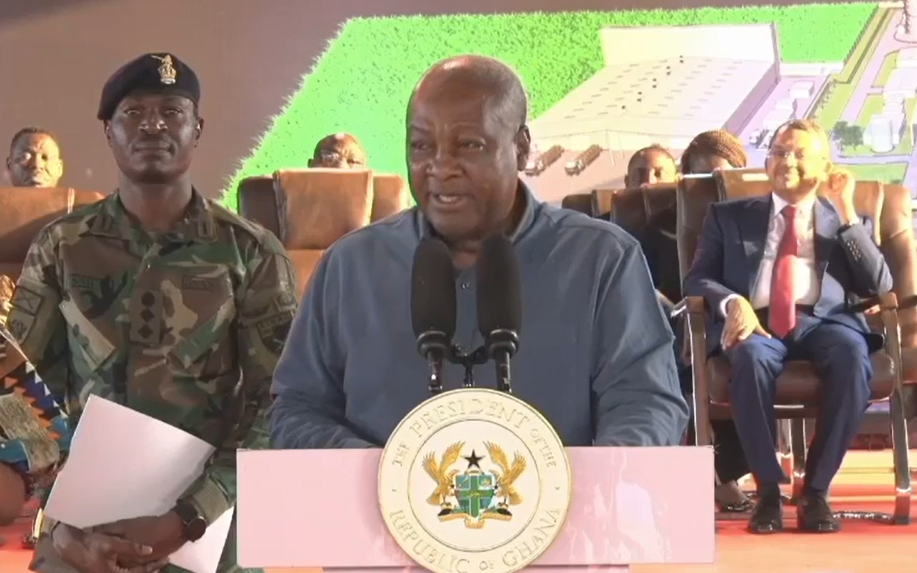
ACCRA, GHANA – Former President John Dramani Mahama praised the enduring strength and maturity of Ghana’s democratic system during the nation's 69th Independence Day address at Jubilee House, stating that its resilience stems from the country's collective ability to engage in robust political competition without resorting to destructive actions. His remarks underscored the critical importance of peaceful contention in maintaining national stability and progress.
Speaking to an audience of dignitaries, traditional leaders, and citizens, Mr. Mahama highlighted Ghana's journey since gaining independence, commending the nation for cultivating a political culture where diverse ideologies can clash without threatening the foundational fabric of the state. "Our democracy has endured because we learned to compete without destroying," Mahama declared, emphasizing the peaceful transfer of power and the respect for electoral outcomes as cornerstones of Ghana's democratic success.
The former president’s message resonated deeply with the spirit of Independence Day, a time for reflection on national achievements and aspirations. He pointed to Ghana's record of successful elections and transitions, often held up as a model for other African nations, as evidence of this unique democratic maturity. This ability to navigate political differences constructively, he argued, has been instrumental in preserving peace and fostering an environment conducive to development.
The Essence of 'Competing Without Destroying'
Mahama's articulation of "competing without destroying" speaks to a nuanced understanding of democratic practice, where the pursuit of power is tempered by an overarching commitment to national unity and the rule of law. It implies a political landscape where opposition parties can vigorously challenge incumbent governments, and vice versa, while respecting the legitimacy of institutions and the outcomes of democratic processes.
Political analysts have long observed Ghana's relatively stable democratic trajectory, attributing it to a combination of strong institutions and a general willingness among political actors to abide by constitutional provisions. Dr. Akua Mensah, a senior lecturer in Political Science at the University of Ghana, commented on the significance of Mahama's statement.
"Coming from a former head of state, particularly one who has experienced both victory and defeat at the polls, Mahama's words carry significant weight," Dr. Mensah noted. "It's a timely reminder, especially as we approach another election cycle, that the essence of democracy lies not just in the freedom to choose, but in the grace to accept and the commitment to build, regardless of who is in power. It's a call for introspection on how our political discourse can remain robust yet respectful."
This principle is particularly vital in a multi-party system where political rivalries can, if unchecked, escalate into social fragmentation. Ghana has, on several occasions, demonstrated its capacity to overcome political tensions through dialogue and adherence to legal frameworks, reinforcing the belief that the nation has indeed learned to manage its political differences effectively.
Historical Context and Future Implications
Ghana's democratic journey has not been without its challenges, including periods of military rule and political instability in its early post-independence years. However, since the inception of the Fourth Republic in 1992, the country has made remarkable strides in consolidating its democratic gains. This period has seen multiple peaceful transfers of power between different political parties, a feat that is often difficult to achieve in nascent democracies.
Mr. Kwesi Nsiah, a prominent governance expert and executive director of the Centre for Democratic Accountability, emphasized the practical implications of Mahama's message for sustained development.
"The strength of any democracy isn't just in casting votes, but in the institutional frameworks and, critically, the political culture that allows for ideological differences without undermining the state or disrupting socio-economic progress," Nsiah stated. "When leaders and citizens alike internalize the idea of competing without destroying, it fosters an environment of predictability and stability, which is essential for investment, job creation, and overall national development."
The former president's address also implicitly called for continued vigilance and commitment from all stakeholders – political parties, civil society, media, and the citizenry – to uphold these democratic tenets. The upcoming general elections will undoubtedly serve as another test of Ghana's democratic maturity, making Mahama's message particularly pertinent.
A Call for Continued Unity and Maturity
The sentiment expressed by Mr. Mahama transcends partisan politics, appealing to a broader sense of national unity and shared responsibility. It serves as a powerful reminder that while political competition is inherent to democracy, it must always be conducted within bounds that preserve peace, respect the rule of law, and prioritize the collective good of the nation.
Nana Ama Owusu, a spokesperson for the Ministry of Information, affirmed the government's alignment with the former president's perspective.
"The government echoes the sentiment that national unity and a commitment to peaceful political engagement are paramount," Owusu remarked. "These are values that transcend political divides and are fundamental to Ghana’s continued progress and prosperity. We believe that by adhering to these principles, Ghana will continue to shine as a beacon of democracy in Africa."
As Ghana looks towards its future, the message from former President Mahama serves as a crucial guiding principle: that the nation's continued success and democratic consolidation hinge on its ability to maintain a vibrant political landscape where differences are debated vigorously, but always with an unwavering commitment to the peace and stability of the republic.