
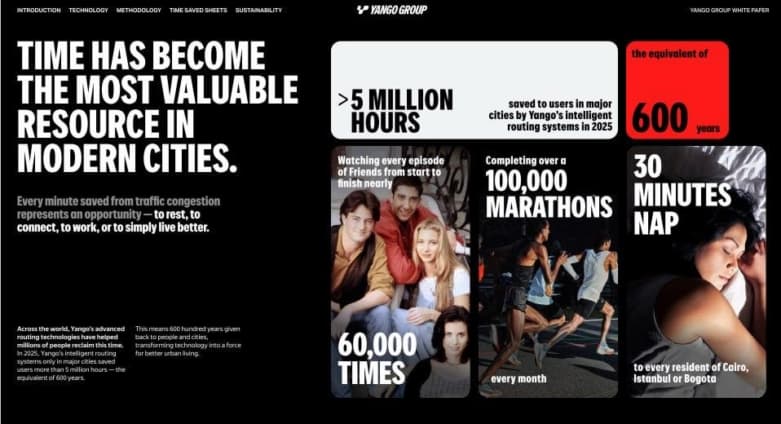
Yango Group, a global technology firm focused on digitalising urban services, has announced that its advanced AI-powered routing technologies saved urban commuters over 5 million hours in 2025 across more than 20 cities equivalent to 600 years of human time returned to local communities.
The results, derived from an analysis of millions of Yango Ride trips in 2025, demonstrate that intelligent routing can deliver measurable improvements in urban quality of life, positioning AI-driven mobility as essential infrastructure for modern cities. Yango’s system uses a sophisticated mix of machine learning models, real-time traffic data, and historical patterns to optimize each journey, simultaneously processing multiple data streams to calculate the most efficient route in milliseconds.
“Five million hours saved isn't a tech metric it's proof that AI can solve real urban problems at scale,” said Adeniyi Adebayo, Chief Business Officer of Yango Group. “We're demonstrating that the next generation of city infrastructure won't be built with concrete and steel alone, but with data, algorithms, and intelligence embedded into everyday services.”
The research compared AI-optimized routes with static shortest-path routes that ignore live traffic conditions, showing significant time savings across diverse urban environments.
In Ghana, total annual time saved exceeded 130,000 hours, with active Yango passengers saving about an hour each. In Lima, commuters reclaimed over 1.1 million hours annually, the largest absolute saving among the cities studied. Residents in Kinshasa saved an average of 6.48% per trip, while Guatemala City users saw the highest efficiency gains at 6.99%. In Abidjan, the most active riders gained more than 2 hours per year individually. Overall, the cumulative effect represents 5 million hours returned to urban economies and communities in a single year.
Yango’s AI processes road characteristics, traffic light patterns, turn complexity, and predictive congestion modeling. Its self-learning architecture continuously refines accuracy by comparing predicted versus actual travel times, creating an adaptive feedback loop tailored to each city’s unique traffic patterns.
Beyond time savings, intelligent routing supports broader urban sustainability goals. By reducing idle time and optimizing traffic flow, the technology enhances fuel efficiency, lowers emissions, and eases local congestion key pillars of smart city development.
As cities face growing populations and increasing motorization, Yango’s findings highlight technology’s potential to tackle infrastructure challenges while improving daily experiences for millions of residents.
Operating in over 35 countries across the Middle East, Africa, and LATAM, Yango Group delivers services that underpin smart urban ecosystems digitising city services and transforming complex algorithms into accessible tools that help cities become more efficient, sustainable, and human-centered.
For full research methodology and detailed results across all cities, visit [link].
.png&w=3840&q=75)