
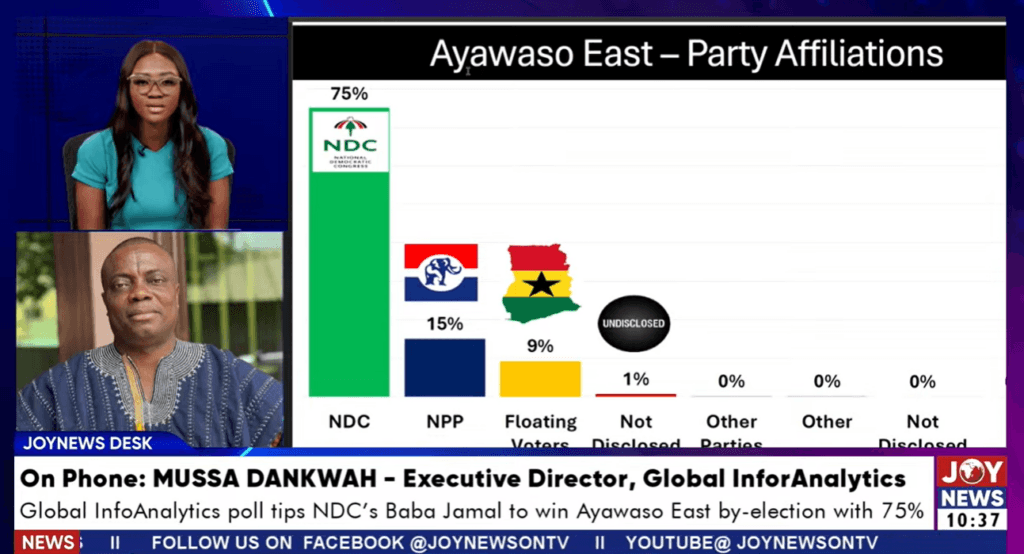
The survey, which was conducted over a period of two weeks, involved a sample size of over 1,000 respondents from the Ayawaso East constituency. Mussa Dankwah explained that the large sample size and the use of a random sampling technique helped to minimize biases and ensure that the results are representative of the entire constituency. "Our team of experts worked tirelessly to ensure that the survey was conducted in a fair and transparent manner, and we are confident that the results reflect the true sentiments of the voters in Ayawaso East," he said.
Defending the Credibility of the Survey
Mussa Dankwah's defense of the survey's credibility is not surprising, given the organization's reputation for conducting rigorous and unbiased research. However, some critics have raised concerns over the potential for biases in the survey, citing the organization's alleged links to certain political parties. In response to these concerns, Mussa Dankwah emphasized that Global InfoAnalytics is an independent organization that operates without any political affiliations. "Our goal is to provide accurate and reliable data that can inform decision-making, and we take great care to ensure that our surveys are conducted in a neutral and impartial manner," he said.
Other experts in the field have also come to the defense of Global InfoAnalytics, praising the organization's commitment to transparency and accountability.
"Global InfoAnalytics has a proven track record of conducting high-quality research, and their surveys are widely regarded as among the most reliable in the industry,"said Dr. Ama Owusu, a lecturer in political science at the University of Ghana.
"While it is natural to have some doubts about the credibility of polls, I believe that Global InfoAnalytics has done a great job in ensuring the integrity of their survey, and their findings should be taken seriously."
Implications of the Survey Findings
The survey findings, which show a significant lead for one of the candidates, have sent shockwaves through the political establishment in Ayawaso East. While some have hailed the results as a reflection of the true sentiments of the voters, others have expressed skepticism, citing concerns over the potential for biases and errors in the survey. However, Mussa Dankwah remains adamant that the findings are reliable and should be taken seriously. "Our survey is not just about predicting the winner of the election, but also about providing insights into the concerns and aspirations of the voters," he said. "We believe that our findings can inform the campaign strategies of the candidates and help them to better address the needs of their constituents."
As the election campaign in Ayawaso East heats up, the survey findings are likely to play a significant role in shaping the debate and informing the decisions of voters. While some may continue to question the credibility of the survey, Mussa Dankwah's assurance of a 95% confidence level is likely to reassure many stakeholders. As Dr. Owusu noted,
"The fact that Global InfoAnalytics has staked its reputation on the credibility of this survey suggests that they have a high degree of confidence in their findings, and that should give us all pause for thought."
In conclusion, the confidence level of 95% expressed by Mussa Dankwah is a significant indication of the reliability of the survey findings. As the people of Ayawaso East prepare to go to the polls, the survey results are likely to be a major talking point, with many candidates and stakeholders scrutinizing the findings and seeking to understand their implications. As the election campaign unfolds, it will be interesting to see how the survey findings influence the debate and shape the outcome of the election. One thing is certain, however: the survey conducted by Global InfoAnalytics has provided a valuable insight into the sentiments of the voters in Ayawaso East, and its findings are likely to be widely discussed and debated in the days and weeks to come.